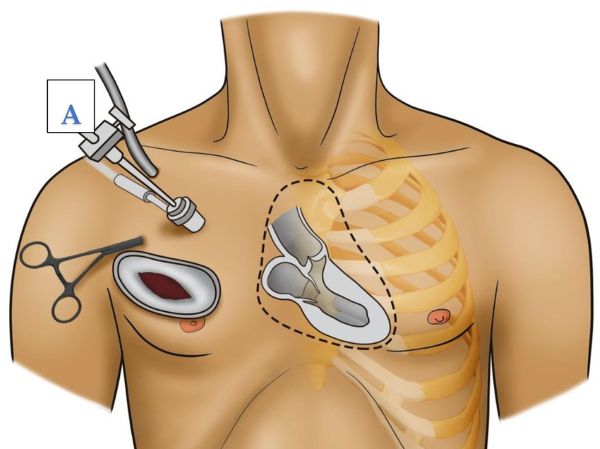
Minimally Invasive Cardiac Surgery (MICS) is an advanced surgical approach used to treat various heart conditions through small incisions rather than the traditional open-heart surgery that requires a large chest incision. This technique offers faster recovery, less pain, and better cosmetic results while maintaining the same effectiveness as conventional heart surgery in selected patients.
What Is Minimally Invasive Cardiac Surgery?
Minimally Invasive Cardiac Surgery involves performing heart procedures through small cuts (5–8 cm) between the ribs or through keyhole incisions, without fully opening the breastbone (sternum). Special surgical instruments and cameras are used to access the heart safely. The goal of MICS is to reduce surgical trauma while achieving excellent clinical outcomes.
Conditions Treated with Minimally Invasive Cardiac Surgery
- Coronary artery disease (selected bypass cases)
- Mitral valve repair or replacement
- Aortic valve replacement (minimally invasive AVR)
- Tricuspid valve surgery
- Atrial septal defect (ASD) closure
- Removal of heart tumors (e.g., myxoma)
- Certain congenital heart defects
- Maze procedure for atrial fibrillation (in selected patients)
Not all patients are suitable candidates. Final selection depends on heart anatomy, disease severity, age, and overall health.
Types of Minimally Invasive Cardiac Surgery
- Minimally Invasive Valve Surgery: Performed through a small incision on the right side of the chest or upper sternum to repair or replace heart valves.
- Minimally Invasive Coronary Artery Bypass (MIDCAB): In this approach CABG is done through left 4th/5th intercostal space for patients with coronary artery disease. Multivessel bypass can be done in this approach including total arterial grafts with equal accuracy and outcomes as compared to conventional approach.
- Robotic-Assisted Cardiac Surgery: Uses robotic arms controlled by the surgeon for highly precise movements through very small incisions.
- Mini-Sternotomy: Involves a partial opening of the breastbone rather than a full sternotomy.
How Is Minimally Invasive Cardiac Surgery Performed?
- The patient is given general anesthesia
- Small incisions are made between the ribs or in the upper chest
- Special instruments and a camera are inserted
- The heart is accessed directly or with support of a heart-lung machine (if needed)
- The procedure is completed with precision
- Incisions are closed with minimal scarring
Benefits of Minimally Invasive Cardiac Surgery
- Smaller incisions
- Less blood loss
- Reduced pain after surgery
- Lower risk of infection
- Faster recovery and shorter hospital stay
- Earlier return to daily activities
- Minimal scarring and better cosmetic results
Preparation Before Surgery
- Blood tests
- ECG and echocardiography
- CT scan (if required)
- Coronary angiography
- Chest X-ray
- Stop smoking
- Adjust medications
- Fast before surgery
- Control diabetes and blood pressure
Recovery After Minimally Invasive Cardiac Surgery
Hospital Stay:
- ICU stay: 1–2 days
- Total hospital stay: 3–5 days (shorter than open surgery)
Home Recovery:
- Return to light activities in 1–2 weeks
- Full recovery in 2-3 weeks
- Less need for strong pain medications
- Cardiac rehabilitation is often recommended to improve strength and heart health.
Risks and Complications
- Bleeding
- Infection
- Irregular heartbeat
- Stroke (rare)
- Need to convert to open surgery (in some cases)
Risks vary depending on the patient's condition and the surgeon's experience.
Who Is Not Suitable for MICS?
MICS may not be recommended for patients with:
- Severe chest deformities
- Extensive previous heart surgeries
- Advanced lung disease
- Emergency cardiac conditions
A cardiac surgeon will determine the best surgical approach.
What is Recovery After MICS
Typical recovery journey after an MICS operation is as follows:
- ICU stay: Often 1-2 days
- Hospital stay: Often 2-5 days for many minimally invasive cases (versus 5-10+ days for open)
- Early mobility: Patients often sit up and walk with assistance within 24-48 hours
- Return to light activities: Often within 2-3 weeks; full recovery often by 6-7 weeks depending on procedure and health
- Wound care: Small incisions need proper care, chest drain removal, pain control, breathing exercises
- Cardiac rehabilitation: Supervised exercise & education to regain strength, stamina, monitor heart function
- Resuming work, driving, travel: Guided by surgeon/cardiologist based on individual progress
What Follow-Up is Needed After MICS
Post-operative follow-up is essential to confirm return to full physical activity.
- Regular outpatient visits with your cardiac surgeon/cardiologist
- Imaging studies: echocardiography to check valve/leak function, graft patency for bypass
- Routine blood tests (kidney, liver, anticoagulation levels if used)
- Lifestyle monitoring: diet, exercise, smoking cessation, blood pressure, cholesterol, diabetes management
- Adherence to Medications: antiplatelets/statins/anticoagulants as required
- Awareness of signs of complications: wound redness/swelling, fever, arrhythmia, breathlessness, leg swelling
- Long-term surveillance: for valve patients, prophylaxis for infective endocarditis and maintenance of anti-coagulation and for bypass patients, management of coronary disease progression is very important for long term healthy life
Recent Advances & Future Possibilities in MICS
With all-round developments in the medical field, MICS technique is also evolving very fast. Main advances in the field of MICS include:
- Increasing use of robotic-assisted cardiac surgery
- Progressively smaller port sites or 'holes'
- Totally endoscopic coronary bypass (TECAB) – Bypass operation performed completely through endoscopes
- Hybrid operating theatre where image-directed and surgical procedures are performed simultaneously
- Improved imaging and 3-D modelling before surgery to plan patient-specific MICS approach
- Better patient monitoring devices
- Smaller and smarter minimal-access instruments
Ongoing research shows that MICS outcomes are increasingly comparable or superior to traditional surgery in properly selected patients.